The inaugural lecture for the Fall 2026 Modern Critical Theory (MCT) Lecture Series, titled “Theory in University,” was held on September 8. Through an overview of three foundational moments in the history of the modern university in the West—namely Berlin around 1810, Urbana, Illinois around 1900, and Berkeley around 1950—Chad Wellmon (University of Virginia) offered what he later described, during the Q&A, as a theory of the university: an attempt to rethink what the university ought to be vis-à-vis what it has become in the United States today. He situated this question against the backdrop of recent conflicts between the federal government and American universities (which have centered on issues ranging from diversity policies to social theory curricula). Wellmon’s lecture was based on his latest book, After the University: Higher Education and the Future of Intellectual Work.
Wellmon contended that the modern university emerged from a settlement between the state and communities of scholars. In its early Prussian form (Berlin, 1810), the university was meant to mediate between two potentially conflicting demands: the autonomy required for scholarly work and the state’s expectation that knowledge serve public purposes.
This settlement underwent fundamental transformations over time. In the American university, the opposition between scholarly autonomy and public utility was reformulated: at Illinois, around 1900, the university became more closely dedicated to industry, state administration, and the production of socially “useful” knowledge. By the postwar Berkeley moment (1950), it had turned into a system for turning institutional inputs into outputs such as degrees, technologies, and trained workers. The university found a socially central role by gradually acquiring extraordinary capacity to distribute knowledge, prestige, capital, and power.
Wellmon repeatedly emphasized that this development produced real goods. He did not argue that universities should never improve material life or contribute to medical research. His concern was the primacy of such goods to the extent that university presidents also invoked them to defend their institutions during recent attacks from the government. This concern, in the introduction to After the University, is articulated as an explicit criticism of such defenses of universities because they obscure more fundamental questions about the university as an institution and the practices it does or ought to contain.
Wellmon distinguishes the external goods of the institution, such as money, prestige, and social utility, from the internal goods of its practices, mainly and namely, “disciplined study.” Over time, the arrangement has made the external goods essential to sustain intellectual practices, but those goods can also come to dominate and distort them.
Although not included in the lecture presented at UIUC, the personal account with which Wellmon opens his latest book clearly illustrates the distinction and why it matters. He describes his father, who lacked a college degree and experienced throughout his life the material and social consequences of that absence. In Wellmon’s words, the difference between possessing and not possessing a BA, can structure how people in the United States “live, work, and die.” At the same time, his father becomes Wellmon’s image of the ideal reader: someone who seriously studied the Bible without credential or professional rewards attached to the activity. Wellmon’s theory seems to aim to recover the internal good of such an attitude toward reading and studying.
Seen against this historical overview, Wellmon’s suggestion in the lecture that the university may now be paying the “debt” of its own success becomes more intelligible. As he reminded us several times, the university has gained so much power over the distribution of credentials and prestige, power, knowledge, and capital that struggles over the university have somewhat inevitably become struggles over those goods themselves. Universities are vulnerable today because they have become central to social and intellectual life. The lecture ended with questioning this very position, if this is the desired or favorable (“healthy”) condition.
As a sociology student interested in contentious politics, one part of the modern university’s history that, to my disappointment, remained almost entirely outside the narrative was the university as a site of political action. This also came up during the Q&A as a broader question about student life throughout the history discussed. This absence was notable also because After the University itself opens with accounts of the spring 2024 protests at the University of Virginia, where, responding to students who joined a pro-Palestinian encampment, the university ultimately called the police. Across the United States that spring, including at UIUC, campus encampments and sit-ins became sites of direct confrontation between student protesters, university administrations, and police forces; hundreds were arrested in the early weeks of the protests alone (for a relatively comprehensive survey, see: Chenoweth et al 2024).
![Demonstrators gathered on the U of I Quad to protest the university’s investments in South Africa [1978]](https://criticism.illinois.edu/sites/default/files/styles/medium_400/public/2026-10/UIUC%20Demonstration%20Smile%20Politely.jpg?itok=kEEKdSwe)
This matters because, if disciplined study constitutes the internal good of the university, while everything oriented toward external social effects remains external, student activism would be difficult to place. It is not knowledge pursued simply for the sake of knowledge. It seeks something outside itself.
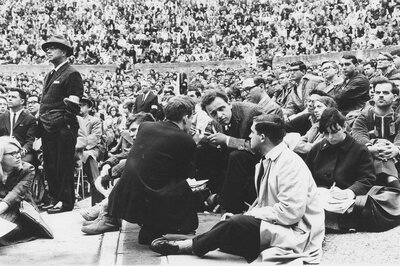
Universities have been important sites of precisely this kind of political practice, and students have been treating campuses not only as places in which the world is interpreted, but as places from which one can intervene in it, as evident in the student sit-ins during the Civil Rights Movement, to the Free Speech Movement at Berkeley (Berkley was also the third historical case in the lecture), to anti-apartheid divestment campaigns and their shantytowns in the 1980s, to the pro-Palestinian encampments of 2024. While the modern American university has developed an ever more pronounced alliance with state administration, industrial production, and labor markets, at the same time political action has also been part of its history, not merely an accidental activity alongside its “real” work.
Like cancer research and the cultivation of professional credentials, political activism similarly seeks to impact the world beyond the university. If all three are external to the internal good of disciplined study, it is unclear why the first two deserve sustained attention in an account of what the university has become and not the third. Yet Wellmon’s position in respect to this was normative, as was made clear in the Q & A with the audience. When he was asked about the “theory” in “Theory in University,” he described his project as an institutional theory of the university. He argued that describing what an institution does already implies, in some sense, what a healthy version of that institution ought to do.
This clarification made the lecture, for me, an odd inauguration for the MCT series. Immanent critique in the critical-theoretical tradition is not merely a way of diagnosing contradictions, but a means of opening possibilities for transforming the social relations that produce them. The idea of disciplined study pursued for its own sake may sound attractive, especially against the expanded institutional activities described in Wellmon’s account. But if we apply this theory of the university to critical theory in the university today, wouldn’t the very aim of opening possibilities for transforming the world fall outside its scope? If the internal good to be recovered is knowledge pursued for its own sake, where, within this account, does praxis belong?
If studying subjects such as inequalities, oppression, racism, neoliberalism, coloniality, settler colonialism, imperialism, and war is an inherent part of intellectual practice, what happens when students attempt to act upon what they have learned? Students of critical theory may be comfortable sitting with contradictions. But my interpretation is that the lecturer suggested that the university should preserve a space where contradictions can be studied, and he seemed to overlook the fact that some of the most important historical moments in American universities (as well as in universities elsewhere) have occurred precisely when those contradictions could no longer remain inside the classroom. A theory of the university that rescues knowledge by separating it from praxis risks preserving precisely the university that critical theory has taught us to question.