"Comics: Immedia et Realia"
Written by Shawn Gilmore (English)
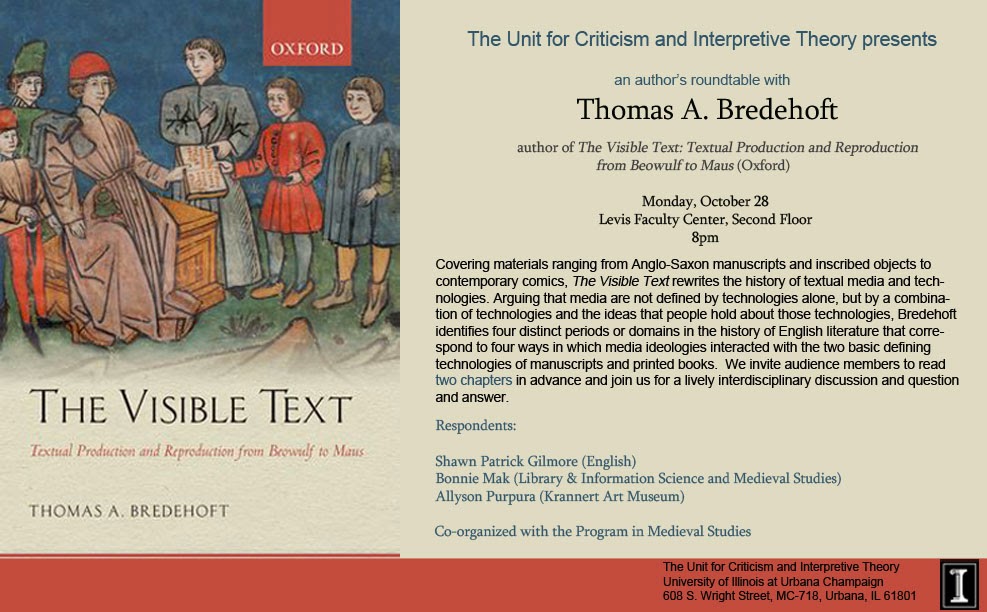
The arguments that Thomas Bredehot puts forward in The Visible Text provide a new and valuable model by which we might reconfigure our notions of the long history of textual production, while also quite usefully highlighting the tension between the textual and paratextual components of various text objects, exposing the linked and shifting relationship between production and reproduction within various eras in the history of print. As a scholar of comics and graphic narratives, I am drawn to Bredehoft’s rather bold claims about the role that comics play at the end of his genealogy of textual forms. So, in what follows, I want to briefly highlight what I read as the key to Bredehoft’s conception of comics, and then move (somewhat tendentiously) to two challenges that this definition poses if we are to move forward with his schema in mind.
Bredehoft’s argument dismisses some traditional assumptions about the aesthetic logic of comics—including the basic assumption that comics are imagetexts and the more foundational assumption that comics constitute a medium—as he carefully delineates comics from the logic of both the facsimile and the edition. Instead, he draws comics into a long history of printed textual works, focusing on the contiguity of their printed forms (including comics books and graphic novels) with previous modes of textual production. What differs with comics, argues Bredehoft, is the relationship between text and paratext, held together by a unified material publishing form—in short, that comics artists are able to blur the typically fixed relationship between text and paratext, which allows them to integrate their work in ways that sets their comics apart from the markers that establish the legitimacy of traditional textual categories, such as the facsimile or the edition.
Following on this, he comes to define comics as production-in-reproduction, asserting that we can know this newer mode of textual production (i.e., comics) only in the specificity of its printed forms. We must, according to this argument, dismiss some traditional categories of legitimization, including a reliance on the authorial original (i.e., drafted comics art before its published version) and instead focus on the aesthetic practices on display in the published comics that are pushing the medium forward. To show these advances in the medium, Bredehoft draws on Art Spiegelman’s Maus and Chris Ware’s Jimmy Corrigan (as well as noting a few features of Milt Gross’ He Done Her Wrong and Alan Moore and Dave Gibbons’ Watchmen). This, however, raises two related issues, which I will briefly outline below.
First is the issue of authorial intent and our subsequent assumptions about the production of particular comics. Bredehoft draws our attention to Maus and Jimmy Corrigan, focusing on how Spiegelman and Ware, respectively, manipulate the paratextual material of their comics—their covers, endpapers, pagination, etc.—“highlight[ing] the radical materiality of comics textuality,” which contributes to “comics’ resistance to the ideology of print” and their “challenge to the notion that ‘the text’ is ideal, imaginary, linguistic, irreal” (149). Here, Bredehoft highlights one key to what I’ve termed elsewhere “the invention of the graphic novel,” or the conceptual and material unification of the components of book-length comics that was necessary to recognize the graphic novel as a new publication format using the medium of comics. However, this awareness of paratextual manipulation is directly premised on a notion of authorial intent and control, as the examples Bredehoft employs all involve an invocation of the intentional aesthetic and stylistic impulses of artists such as Ware and Spiegelman.
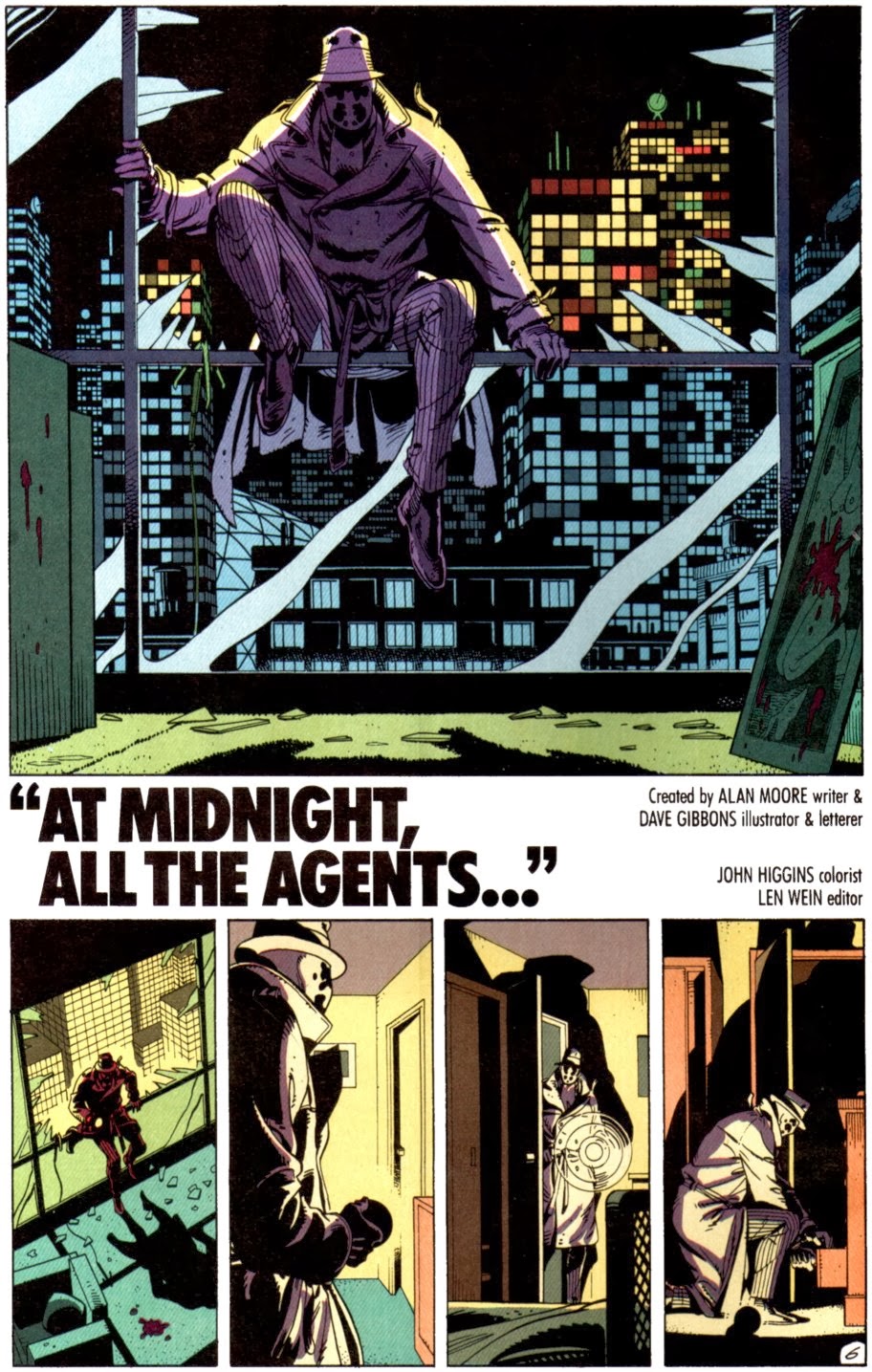 |
| Watchmen #1 (Sept. 1986), p. 6, as it appeared in serialization |
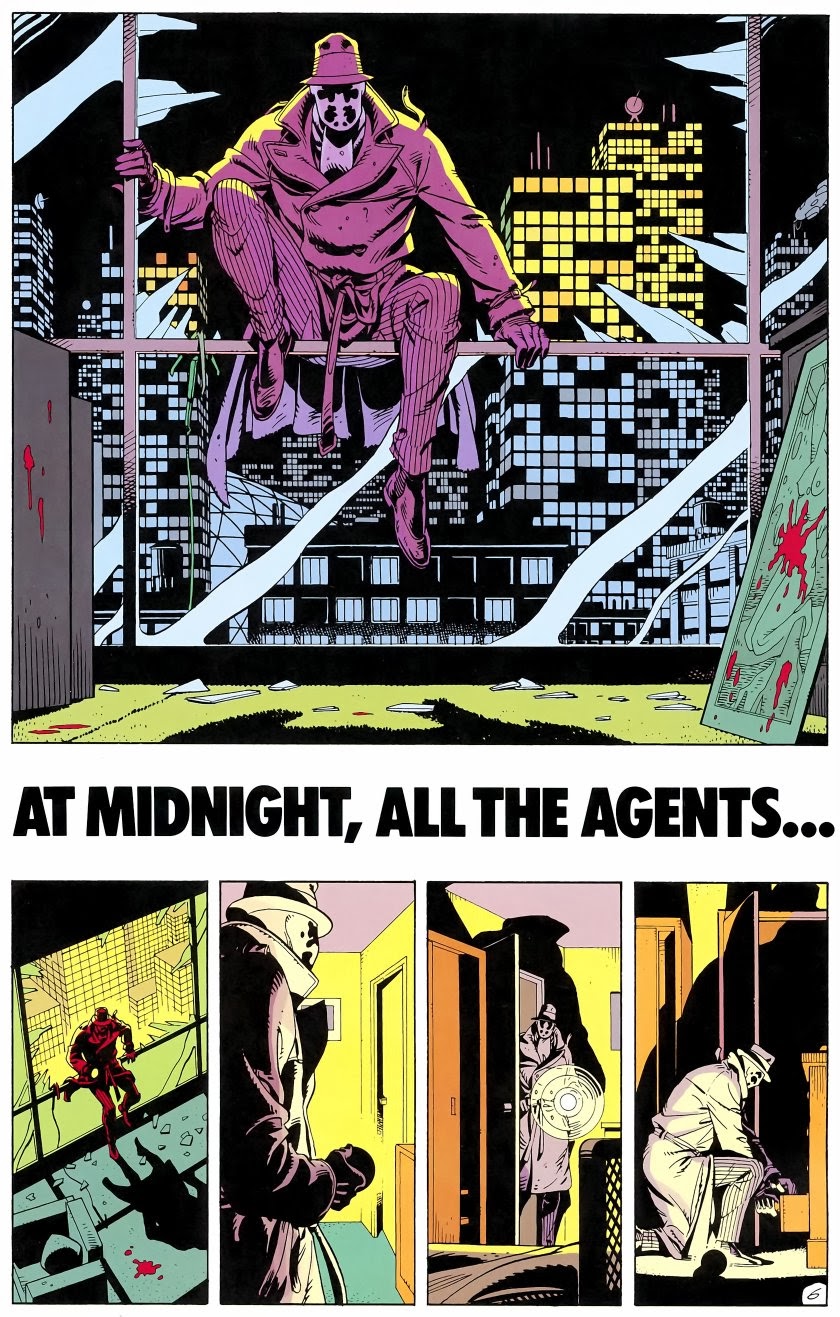 |
| Watchmen (1987), p. 6, as it appears in collected editions |
This brings me to a second concern: namely, the exceptional nature of the “comics” under consideration. Bredehoft uses the term “comics” in an unconventional sense—to designate a genre of works that a very small subset of comics artists have been able to produce when given a good deal of editorial control over the final material terms of their publication. As Bredehoft puts it, these “authors are beginning the work of incorporating these formal and ideological innovations into their works, and where the genre of comics is ultimately headed may not yet be either clear or fully determined” (155). While I concede the important boundary-pushing of these creators, I am concerned that their exceptional position limits their analytic usefulness. Much as I admire Ware and Spiegelman, they are both allowed editorial liberties that most comics creators are not. If the majority of comics creators are not allowed this range of aesthetic possibilities, are we truly talking about comics? About a particular vanguard of comics?
Perhaps more importantly, Spiegelman and Ware are the beneficiaries of a long history of comics artists—of which both are well aware—working in recognizable comics formats since at least the middle of the 19th century. What, finally, do we do with that long history of visual innovation and juxtaposition, what I’ve called elsewhere visual parataxis, which only recently has entered the modern world of printed books in the 20th century? If Bredehoft’s notion of comics describes a possible future of comics, how then are we able to sync these notions up, to use his fascinating framework and terms such as production-in-reproduction, to apply to the wider range of comics and graphic narratives as they have been and are now practiced?