 Molecular Vital Politics of Race: Affirming Life Through Biopower and BiDil
Written by Rico Kleinstein Chenyek (Phd/MD Student: Institute for Communications Research, Medical Scholars Program, & Latina/Latino Studies)
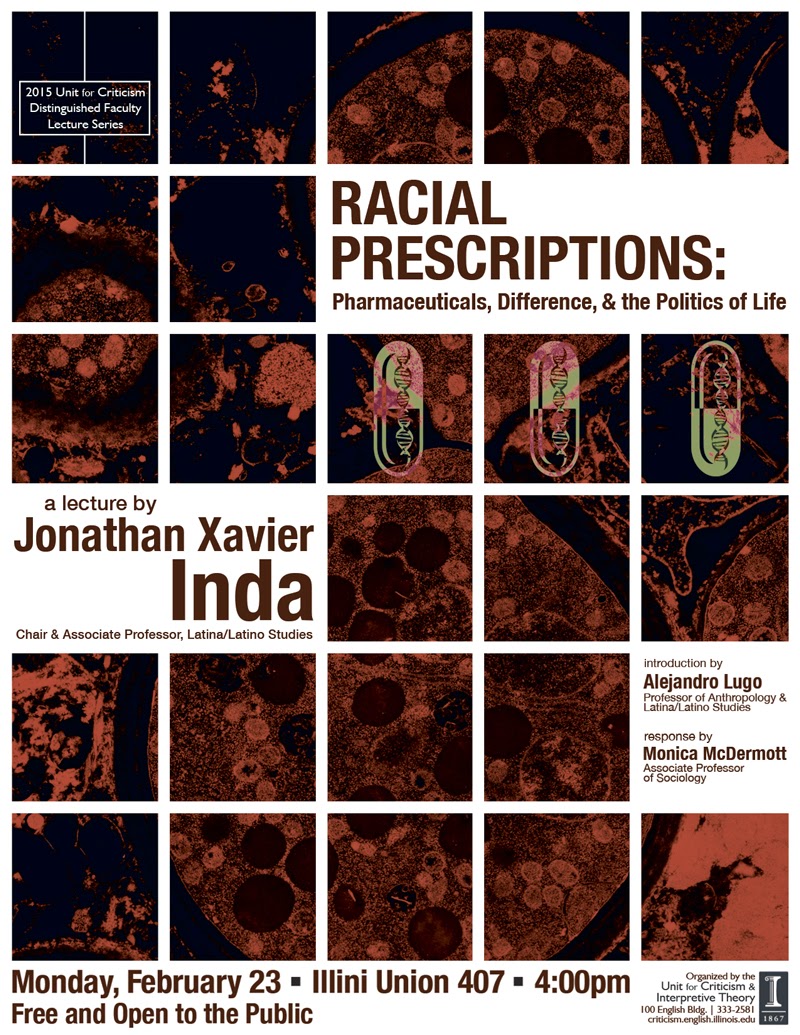
In the age of genomics and individualized genetic health sciences, scholars have begun to explore the implications of new forms of medicalized racialization. Jonathan Inda’s (Latina/Latino Studies/ Anthropology) Unit for Criticism and Interpretive Theory Distinguished Faculty Lecture, "Racial Prescriptions: Pharmaceuticals, Difference, & the Politics of Life,” addressed the double-edged effects of recent scientific research to develop pharmaceuticals targeted at racial minorities, such as the drug BiDil, which was marketed to African Americans. Following an introduction by Alejandro Lugo (Anthropology/Latina/Latino Studies) who located Inda’s current research on race and medicine work within the context of his earlier and ongoing research on immigration, criminalization, governmentality, and the regulation of citizenship (see Targeting Immigrants, among others), Inda introduced the main object of his study: isosorbide dinitrate/hydralazine HCL, or BiDil®.
Prof. Inda’s talk and its title were drawn from his recent monograph, which explores the politics of dealing with health disparities by developing and marketing pharmaceuticals targeted at specific racial minorities. BiDil is a pharmaceutical drug developed by Dr. Jay Cohn to treat congestive heart failure by opening blood vessels so the heart does not work as hard, thereby relieving some of the symptoms. In the late 1990s, after initial clinical trials designed for the general population produced inconclusive results, the Food & Drug Administration (FDA) rejected the drug. However, Dr. Cohn later developed a study for BiDil with only self-identified African Americans. This study showed a significant increase in survival and quality of life for those who took BiDil in comparison with the controlled placebo group. In fact, as the homepage for BiDil.com for health professionals advertises in one of their “Did You Know” facts, “the African American Heart Failure Trial (A-HeFT) was terminated early following a recommendation from the independent Data Safety Monitoring Board due to a significantly lower mortality rate in the BiDil group.” In other words, since the study showed quick and pronounced benefits, the trial was cut short. With these new results, Dr. Cohn returned to the FDA seeking approval for the drug. He also buttressed his case by drawing the support of numerous Black professional, political, and medical organizations, who were motivated by the urgent need to address racial health disparities in their community. Cohn received approval of the drug for use only for self-identified African Americans, making it, in June 2005, the first and only pharmaceutical approved by FDA for a specific racial group to this day.
 |
| Image taken from Bidil.com homepage |
However, Inda contends that BiDil is far from problem-free on both scientific and political fronts. Scientifically, through its approval as a drug only for African Americans, BiDil gives the impression that it will work for all African Americans and only for African Americans, thus flattening out the heterogeneity of Blackness, genetically and otherwise. Furthermore, in standing out as the only drug approved solely for African Americans, it ignores the overwhelming consistency in drug response across racial difference as demonstrated by Steven Epstein. Ultimately, in approving BiDil solely for those that self-identify as African Americans, a process of racialization and self-identification that is extremely varied gets reduced to a specific biological difference whose genetic basis remains uncertain to this day. (There is no genetic or otherwise biological marker that determines BiDil sensitivity in people with congestive heart failure based on self-identification.)
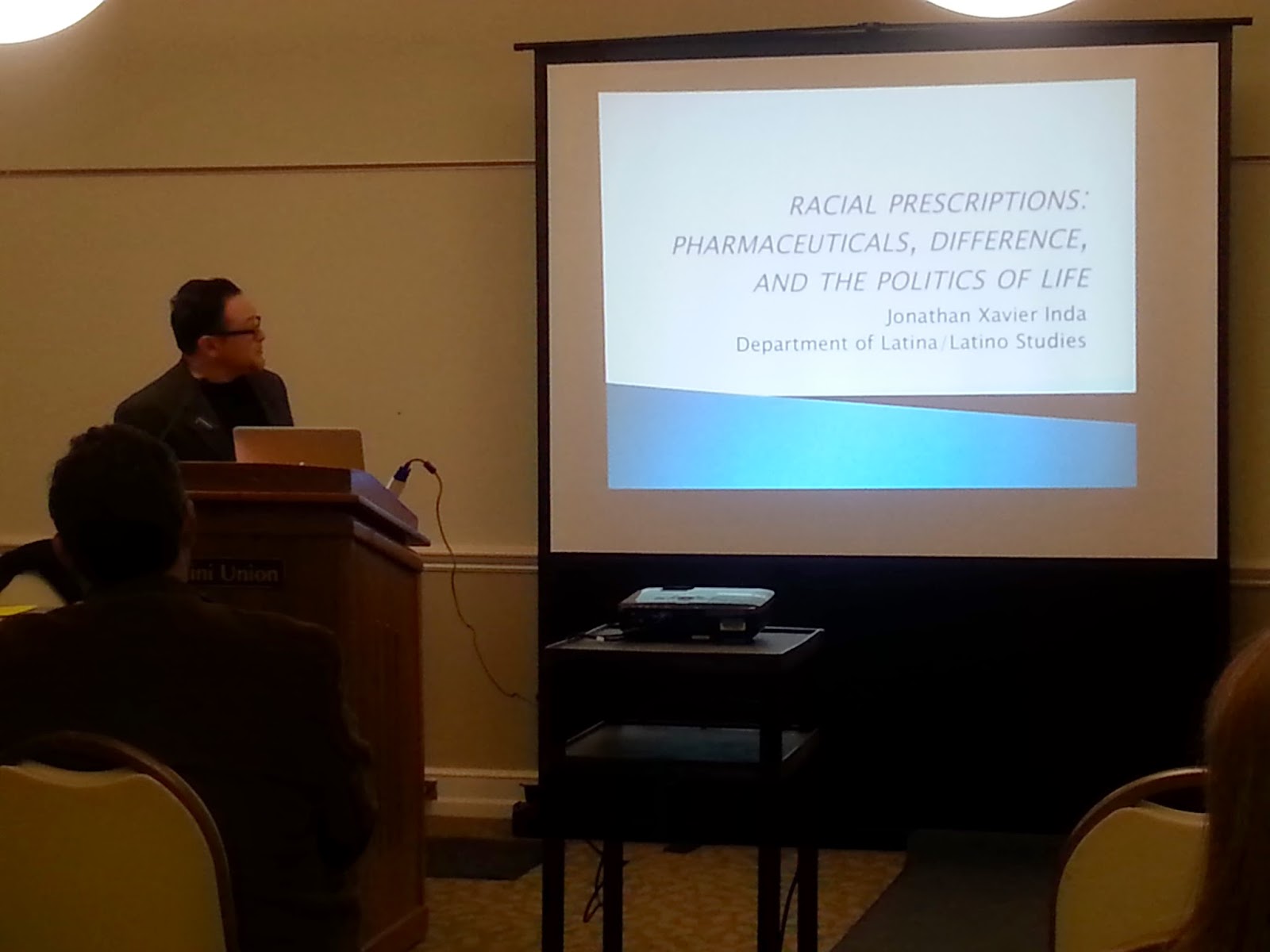 |
| Jonathan Xavier Inda (Photo Credit: Rico Chenyek) |
Following Dr. Inda’s talk, Monica McDermott (Sociology) provided a response commenting on the importance of critiquing how science and medicine assert power within our current political reality, especially as they appears to foster life rather than explicitly seeking to eradicate it. Thus, McDermott contends that in a postracial era that figures race as a legacy of the past that is no longer tied to ongoing discrimination, not only does medical racialization do violence to non-white subjects, but it also justifies the withdrawal of necessary social welfare and support. While McDermott understands how Black people and organizations welcomed the targeted research and recognition of African American health inequalities in the development of BiDil, she reiterates Inda’s critiques. She observes that BiDil is capable of producing a crisis of identity in, for example, a hypothetical self-identified African American seeking an effective treatment through BiDil based solely on racial identification, but who does not respond favorably to the drug. McDermott further argues that such biological renderings of race reify racial admixture as somehow less real. They also contribute to the same line of thinking that produces the white supremacist desire to locate particular combinations of genes, such as a “warrior gene,” that would identify and explain the source of violence and aggression in Black and Latino inner-city youth.
Following the formal lecture, attendees engaged in thought-provoking discussion linking Inda’s research to developments in epigenetics that explores how the environment may become coded in one’s DNA and how such a line of thinking may similarly bolster arguments about cultural deficiency or poor childrearing as the cause behind racial health disparities. Questions also yielded discussions regarding the possible future discovery of a biological factor linked to BiDil sensitivity that would then potentially show race to be irrelevant to BiDil efficacy. Another thread in the discussion focused on the overall failure of BiDil to bring awareness about congestive heart failure or to reach the global market as developers had initially hoped. Inda pointed out that strategies of moving pharmaceutical drugs to racially-specific markets overseas have emerged such as in the case of Iressa, a drug used in lung cancer treatment, which was developed in the US and later marketed in Asia as racially specific for Asians. The discussion concluded with Inda’s reflection on the connection between his earlier work and this research as being shaped by a concern with examining processes of racialization.