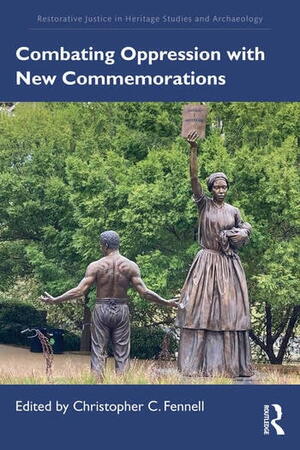
Combating Oppression with New Commemorations
Combating Oppression with New Commemorations examines the ways in which marginalized groups can confront oppressive regimes through commemorations and advocacy of their own heritage.
Presenting case studies from across the globe, the volume provides invaluable insights into the diverse strategies and various disciplinary approaches being used to counter oppression through commemorations of the heritage of marginalized groups. Reminding the reader that such commemorations are often created by individuals who have directly confronted traumas of oppression, contributors emphasize that their survivance, successes, and vitality are tributes to human resilience and creativity. Chapters also demonstrate how such commemorations can advance recognition of the group’s diverse legacies and cultural identity and help enhance social and economic equities for that population across local, regional, and national scales. It is also made clear that they can provide resources for reconciliation negotiations with other social collectives who seek to oppress the marginalized group. These dynamics can facilitate truth-telling, accountability, recovery of unrecorded histories, revitalization, increments of healing, and efforts to avoid future repetitions of past and present social traumas.
Combating Oppression with New Commemorations will be essential reading for academics, and students working in heritage studies, archaeology, anthropology, material culture studies, landscape analysis, and museum studies. It will also be of great interest to practitioners and activists around the world.

Tears for Tears: Aesthetics in Grief Minor
Tears for Tears documents moments of tension, negotiation, transformation, and incommensurability between singular loss and mass death through the work of contemporary minoritarian artists. These artists interrogate the cultural, social, and political enmeshment of death by questioning the interior and exterior conditions of loss. Charting communal, singular, ongoing, and impending loss due to state-sanctioned violence, colonial racial capitalism, natural disaster, and social and personal circumstances, Sandra Ruiz underscores the affective entanglements across death that reshape the topography of grief into portals of possibility.
Drawing from original interviews, familial artifacts, images, and personal archival notes of artists—much of which have never been written about before—the project centers the minoritarian artist as living with and against death in everyday life and art practice. In doing so, the manuscript stages an archival and ideological intervention into the life of grief for minoritarian subjects and artists.
Moving across performance and video art, sculpture, dance, music, theatre, and poetry, Ruiz highlights the relationship between everyday life and staged events as a critical lens to rethink structures of colonial and imperial spatial temporalities of grief. Offering invaluable insights into the production of these works and performances, Ruiz reveals how these artists move across social, corporeal, and psychic constructions of sorrow in their art practices—often working from parental loss into the domain of communal death—and see grieving, however painful, as an act of empowerment, transformation, growth, and communal building.
Islamicate Environments: Water, Land, Plants, and Society
Islam burst forth from Arabia in the seventh century and spread with astonishing speed and force into the Middle East, Asia and northern Africa and the Mediterranean. While its success as a dominant culture has often been attributed to military strength, astute political organization, and religious factors, this Element focuses on the environmental conditions from which early Islamic societies sprang. In the belt of arid land that stretches from Iran to the Maghreb (Spain and Morocco)-i.e. the territories of early Islam-the adaptation of natural water systems, landforms and plant varieties was required to make the land habitable and productive.